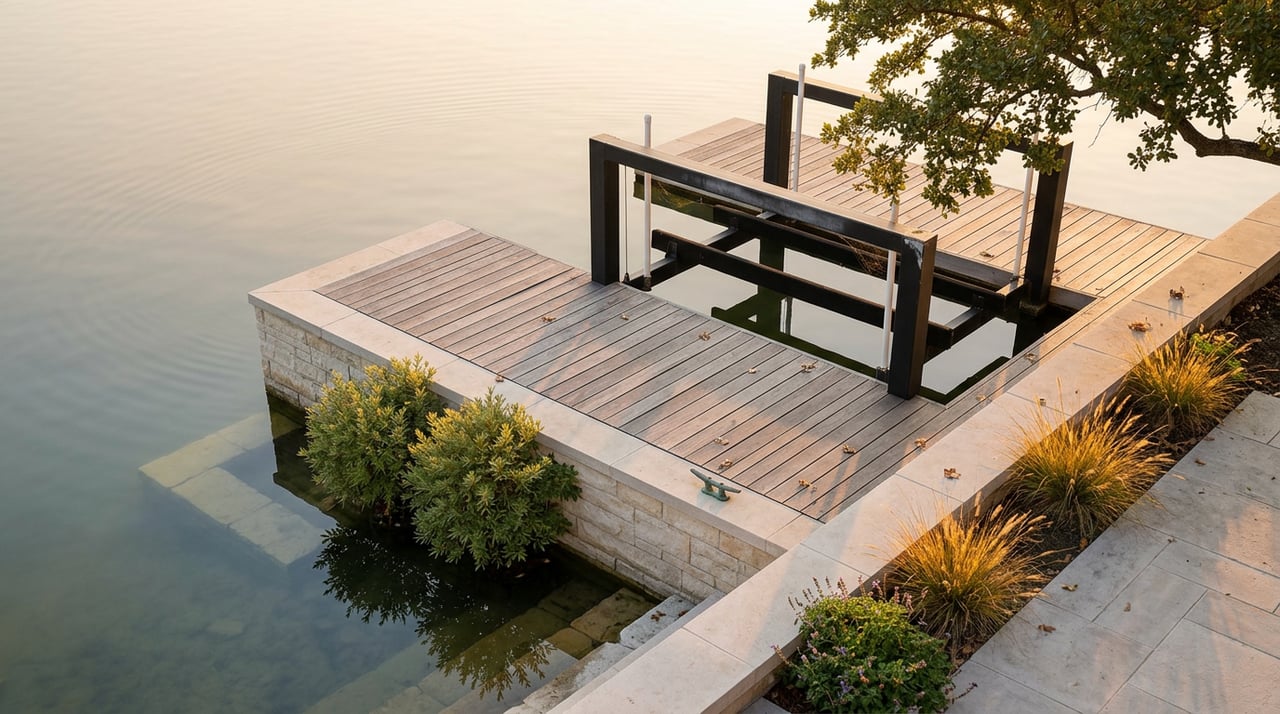
Lake Austin Drawdown 2026: Why the Real Window Is Shorter
August 27, 2026
August 27, 2026
Sometime around the second week of October, the water along Lake Austin's shoreline is going to start disappearing. Not all at once. About a foot a day, quietly, until docks that have floated a few feet above the mud for years are suddenly sitting on it. Boat lifts will hang empty over exposed limestone. Bulkheads that have been underwater since the last Bush administration will see daylight.
This is the first planned drawdown on Lake Austin since 2017, announced by the City of Austin and the Lower Colorado River Authority on August 20. If you bought your place after that year, you have never seen this lake at this level. If you've been here longer, you might remember it happening more often. Either way, the calendar on this one is more complicated than the headlines suggest, and the part that actually matters for anyone with a dock is not the seven weeks everyone's talking about. It's the three weeks buried inside them.
Between 2001 and 2011, LCRA drew Lake Austin down eight separate times, mostly to knock back invasive aquatic vegetation before it took over coves and boat slips. Since 2011, there has been exactly one, in 2017. That's the baseline. A nine-year gap between planned drawdowns is not routine maintenance on this lake. It's an event.
The city requested this one in response to what officials are calling stakeholder demand, and the reasons line up with what property owners have been asking for: better access to work on docks, bulkheads, and boat slips, plus room for Austin Fire and Austin Parks and Recreation to handle their own maintenance while the lakebed is exposed. There's also a vegetation angle. A Texas Parks and Wildlife survey conducted in June found 575 acres of hydrilla and 75 acres of Eurasian watermilfoil in the lake. Hydrilla actually dropped from 592 acres back in February, but watermilfoil climbed from 58, so the total footprint of invasive plant life on Lake Austin held roughly steady even as the mix shifted. A drawdown exposes shallow-water growth to air and lets crews get at what's been hiding along the shoreline.
The drawdown is scheduled between Mansfield Dam and Tom Miller Dam, and the dates matter more than the headline "October through November" framing suggests.
| Dates | What's happening | Elevation |
|---|---|---|
| Oct. 12 | Drawdown begins, lake drops no more than about 1 foot per day | Starts at normal range, roughly 491.8 to 492.8 feet |
| Oct. 12 through early November | Gradual lowering, about three weeks to reach target | Descending toward 481.8 to 482.8 feet |
| Early to mid-November | Lake holds near its lowest point | 481.8 to 482.8 feet above mean sea level |
| Nov. 24 | Refill begins, water released from Lake Travis at up to 2 feet per day | Climbing back toward normal |
| Nov. 30 | Lake expected back at normal operating range | 491.8 to 492.8 feet |
Read that middle row again. The lake doesn't sit at its lowest, most workable level for the full seven weeks between October 12 and November 30. It takes roughly three weeks just to get there, and refill starts November 24, which means the truly stable low-water window, the stretch where a dock that's usually in six feet of water is actually sitting in something closer to knee-deep, runs from about the first week of November to the fourth week. That's closer to three weeks than seven, and it closes just two days before Thanksgiving, which is not a lot of runway for anyone waiting until the holidays slow down to start a project.
City and LCRA officials have also been upfront that this schedule isn't locked in stone. Flooding or a power grid strain could shorten or cancel the drawdown altogether, and both agencies say they'll monitor conditions and announce changes if the timetable shifts.
This isn't only a dock-owner story. Three public access points shut down for the full Oct. 12 through Nov. 30 window:
If you launch a kayak or a ski boat from any of those spots on a normal Saturday, plan around it now rather than finding out at the ramp. The disruption reaches local businesses too. Big Tex Boat Rentals has already told customers its Lake Austin fleet won't be available during the drawdown window, with existing reservations shifting over to Lake Travis instead. If dock-and-dine has been part of your fall plans, expect that to look different this year.
Here's the part that catches people off guard. A lower lake doesn't mean the rules disappear. The City of Austin still requires a permit for constructing a new boat dock, repairing an existing dock or bulkhead, or removing sediment from the lakebed, drawdown or not. What's changing is that Austin Development Services is putting together a dedicated Site Plan Exemption application specifically for minor dock and bulkhead repairs during this window, meant to speed up the process for smaller jobs. As of the city's own announcement, that application was still described as coming "in the coming weeks," not yet live.
That gap matters. If you're hoping to use the low-water period to fix a bulkhead or clear debris around a lift, the fast-track paperwork you're counting on may not exist yet by the time the water actually gets low enough to work in. The city is holding a community open house on Wednesday, September 9, from 6 to 8 p.m., at the Permitting and Development Center, 6310 Wilhelmina Delco Drive, Room 1407, specifically to walk residents through the drawdown process and what permitting will look like. If you have shoreline work you've been putting off, that meeting is the place to get ahead of the paperwork rather than starting cold once the lake is already low. Full permitting details are posted at AustinTexas.gov/Boat-Docks.
Longtime residents who remember the older drawdown pattern may notice this one is scheduled differently. Winter used to be the default season for lowering the lake. That changed after Winter Storm Uri in February 2021, when LCRA determined it would no longer run planned winter drawdowns on the Highland Lakes, because the hydroelectric generators at those dams need to stay fully available to support the Texas power grid during cold-weather emergencies. Planned drawdowns now happen in the fall instead, which is part of why this one lands in October and November rather than January.
It's a small piece of civic plumbing, but it explains something residents might otherwise chalk up to arbitrary timing. The window exists where it does because of a decision made in response to a statewide grid failure, not because fall happens to be convenient for dock repair.
So what does all of this add up to if you own on the water. The lake starts dropping October 12, but if your dock sits in deeper water, you likely won't see meaningful exposure until closer to late October or early November, once the level nears that 481.8 to 482.8 foot target. From there, you have until roughly November 24, when refill begins, before the water starts climbing back at up to 2 feet a day. That's the real window for anything that requires dry ground or shallow water at the base of your dock. Everything before it is transition. Everything after it, the lake is already coming back up.
If you have a bulkhead crack, a lift anchor that needs resetting, or sediment built up around a slip, the smart move is lining up a contractor now and having your permit questions answered at the September 9 open house, so you're not starting the process the same week the water finally gets low enough to work in. Property owners who wait until mid-November to figure out whether they need a permit may find the window closes before the paperwork does.
We've also written about how Lake Austin's constant water level shapes home values here on a lake that almost never fluctuates the way its neighbors do, which is exactly why this drawdown feels so unusual to residents. And if you're looking for the version of Lake Austin life that doesn't involve exposed limestone and closed boat ramps, a perfect day on the lake is still very much available before October 12 arrives.
Nine years is a long time between drawdowns. Whether you use this one for dock repairs, plan your fall boating around the closures, or just want to watch the shoreline change shape for a few weeks, knowing the real calendar beats the announced one.
If you have questions about how this affects a specific stretch of shoreline, or you're weighing dock or bulkhead work against other plans for your Lake Austin property, Johnny Ronca has spent years working alongside the people who live on this lake and know its quirks firsthand. Let's Connect and talk through what makes sense for your place before the water starts moving.
Stay up to date on the latest real estate trends.








I am committed to guiding you every step of the way—whether you're buying a home, selling a property, or securing a mortgage. Whatever your needs, I've got you covered.
7415 SOUTHWEST PKWY BLDG 2 STE 200 AUSTIN TX 78620