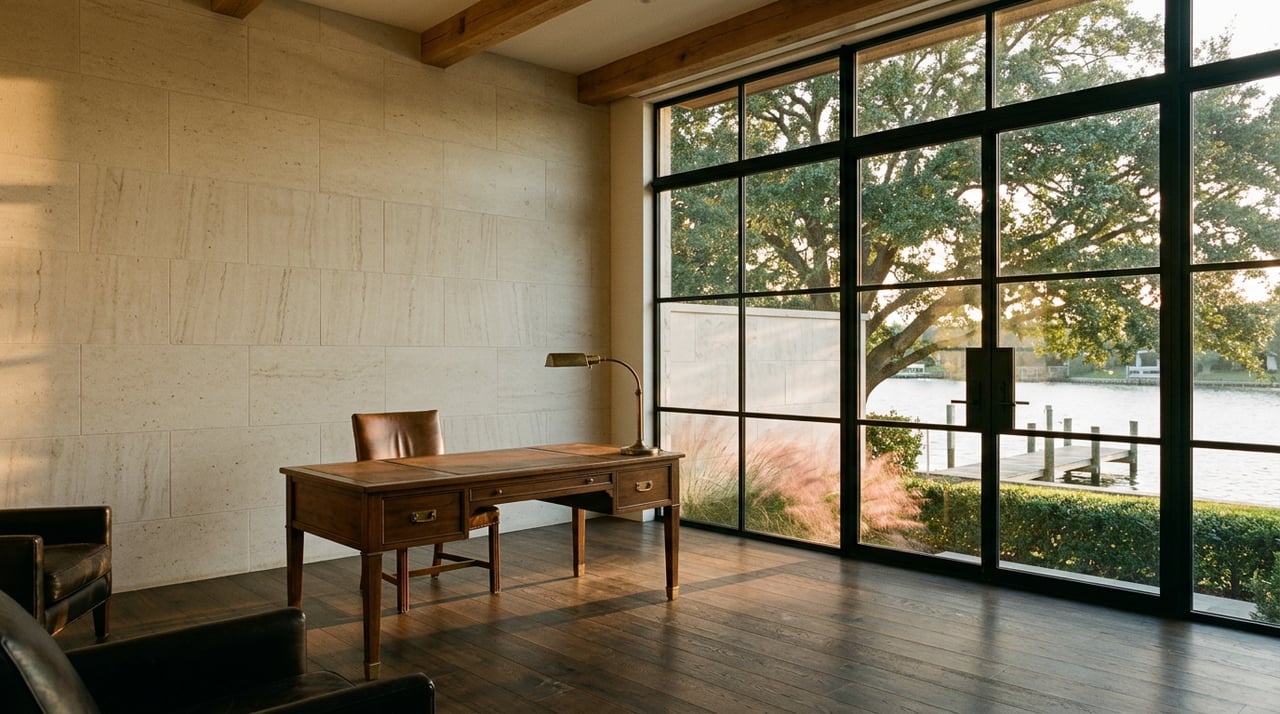
On Lake Austin, the Line on the Map Decides More Than the Price Does
September 3, 2026
September 3, 2026
In April 2026, a two-lot assemblage on Bruton Springs went to market with roughly 4.25 acres, plans already drawn by architect Michael Hsu, and an address inside Eanes ISD. On paper, it read like the easiest kind of Lake Austin deal to close: real acreage, a recognizable architect, a school district families already want. What actually determines how smoothly that closing goes has nothing to do with the acreage or the architect. It comes down to which side of an invisible line the property sits on, and whether the buyer finds out before the option period ends or after.
That line runs through Lake Austin more than most buyers realize. Some homes sit inside the City of Austin's full-purpose jurisdiction. Others sit in unincorporated Travis County. A handful have been deannexed from the city entirely, and this year some of those listings have started advertising that fact as a feature rather than disclosing it as a diligence item. Two homes with similar frontage, similar price, and similar dock condition can face completely different permitting paths, completely different short-term rental eligibility, and completely different impervious cover math. Price sets what you pay. Jurisdiction sets what you're allowed to do once you own it.
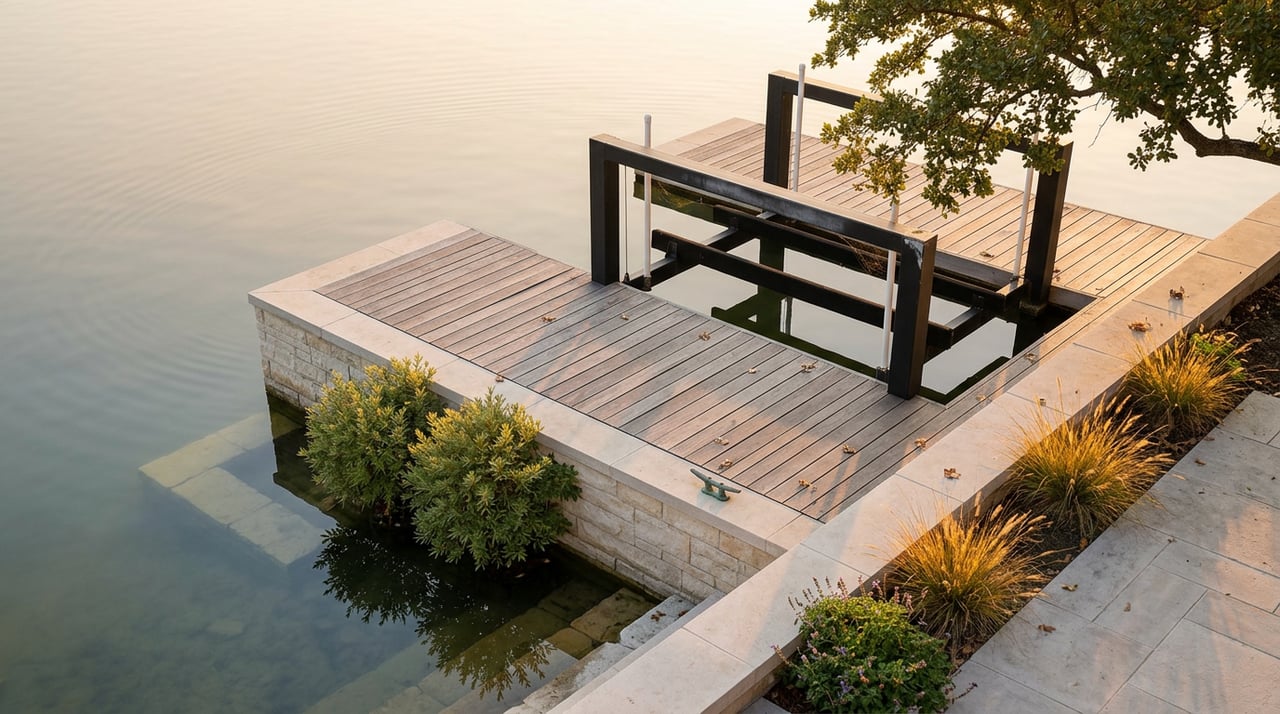
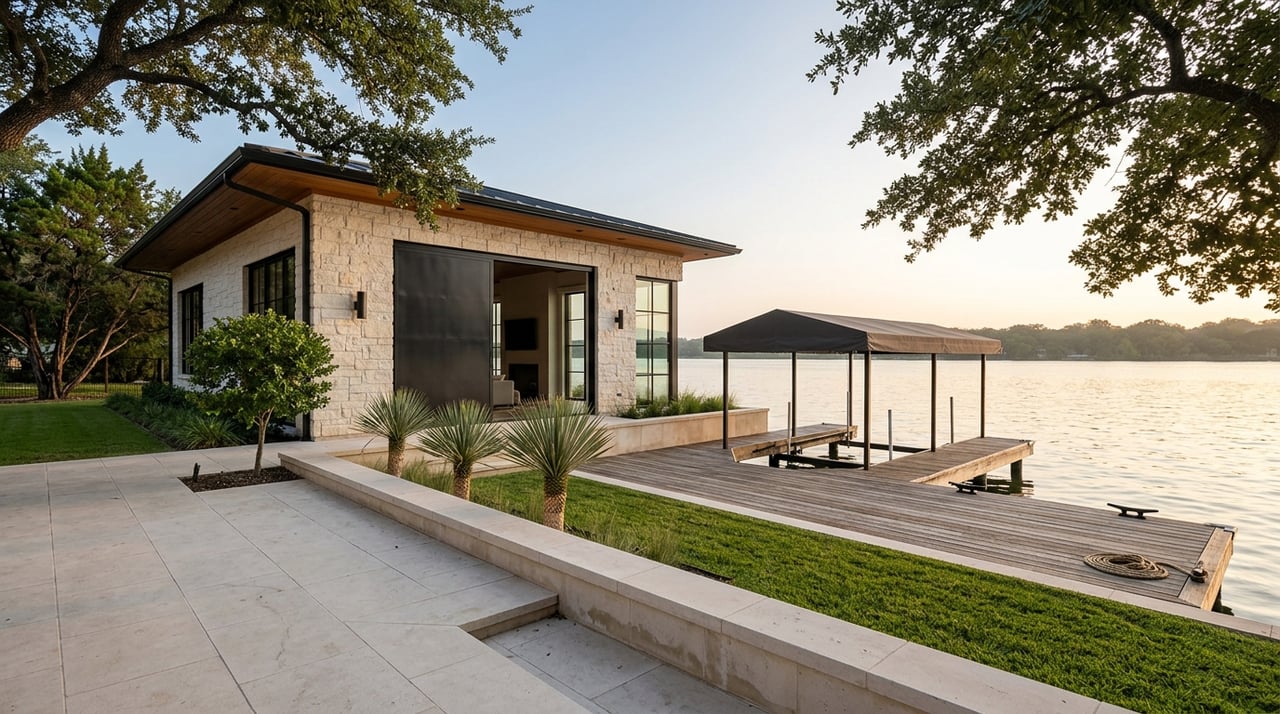
Most buyers assume the Lower Colorado River Authority runs the whole show on the Highland Lakes. It doesn't, not on Lake Austin. LCRA regulates docks on Lake Travis, Lake LBJ, Lake Marble Falls, Lake Buchanan, and Inks Lake. On Lake Austin specifically, the City of Austin issues the dock permit, with the Austin Parks and Recreation Department as the point of contact for dock questions. LCRA still matters, since it holds recorded shoreline easements on many parcels and schedules the periodic lake lowerings that give owners a window to repair docks and retaining walls, but the construction permit itself is a city matter inside city limits.
Step outside those limits, into unincorporated Travis County, and the rulebook changes. County building, septic, and floodplain rules apply instead of the city's land development code, and the impervious cover calculation changes with them. A separate program, adopted in 2013 as Ordinance 20140626-113, requires existing docks to carry a Boat Dock Registration with address signage visible from the water, a step distinct from the construction permit itself and one that's easy to assume transfers automatically with a sale. It doesn't always.
Then there's the smaller category: parcels formally deannexed from the City of Austin. Those parcels reshuffle both dock rules and short-term rental eligibility at once, and this year some active listings have started naming deannexation directly in their marketing copy.
The current setback and impervious cover rules on Lake Austin came out of a genuinely contentious rulemaking process. During the 2014 debate over tightening shoreline setbacks from 75 feet to 100 feet, the city's own environmental officer, Chuck Lesniak, put the tradeoff plainly:
"The ship sailed on Lake Austin being a functioning ecosystem a long time ago."
The council ultimately kept the 75-foot line as what one board member called a reasonable compromise between habitat protection and buildable property. That compromise is still the rule today, and it's why a shoreline setback area gets excluded from impervious cover calculations rather than counted against a lot's buildable footprint. It also explains why the rules read as a patchwork: they were built as a patchwork, negotiated parcel category by parcel category, and they still function that way.
As of July 2026, homes on Lake Austin were trading at roughly $597 per square foot against a City of Austin median near $302, with a median sold price close to $1.2 million, 37 active listings, and 215 closed sales over the trailing twelve months, according to ACTRIS data. That's an unusually small pool competing for an unusually wide price band. Entry-level waterfront with real compromises starts in the several-million-dollar range. Trophy estates push well past ten million. In 2025, four of Austin's ten highest residential sales sat along Lake Austin's banks, including the year's top trade at $16.9 million, and this year's asking prices have pushed further still: $15 million at 2503 Edgewater Drive, $19 million at 4625 Rockcliff Road, and an undisclosed figure at 1901 Westlake Drive marketed as a potential record for the city, according to Forbes' May 2026 reporting.
With that little supply, buyers compete hard, and the jurisdictional questions are exactly the kind of diligence that gets rushed under deadline pressure. That's the real cost of scarcity here. It isn't just that prices climb. It's that the friction most likely to blow up a closing is also the friction easiest to skip when three other buyers are circling the same dock.
Here's where the incentive gets interesting. A listing agent marketing a deannexed parcel has every reason to frame it as flexibility: fewer city permitting layers, potentially different short-term rental math. A buyer reading that copy has every reason to treat it as a bonus rather than a research assignment. Both instincts are understandable. Neither one changes what actually needs to happen before closing.
Two questions matter more than the marketing language. First, does the existing dock's authorization actually transfer to a new owner, or does it require formal notification or reapplication? Second, if a dock is ever damaged and needs a full rebuild rather than a repair, does that trigger current code and erase whatever grandfathered footprint the original structure carried? An 1,800-square-foot two-slip boathouse that looks fine today can become a very different negotiation the day after a windstorm, if the buyer assumed a like-for-like rebuild was automatic.
Short-term rental plans carry their own version of this trap. Austin's STR program is regulated by city ordinance and licensed annually through the city's Development Services Code Compliance, with new platform-level reporting rules that took effect July 1, 2026. That licensing structure applies inside the city's jurisdiction. A property outside it, whether in the extraterritorial jurisdiction or unincorporated county, isn't automatically covered by the same requirement, which is precisely why the jurisdictional line matters more to an investor's pro forma than the square footage does.
The clearest proof that price and jurisdictional risk are separate variables sits in the market's product mix itself. A seven-structure waterfront compound at 12811 River Bend Road, built in 1983 by an owner-architect and still held by the same family, listed this August for $3.75 million, while comparable lots less than half a mile away were asking twice that. The gap has nothing to do with permitting risk and everything to do with condition, character, and how a buyer values an unconventional layout of cabins, a boathouse, and an interior elevator built by hand over four decades. Meanwhile, a buyer touring that property and a buyer touring the $19 million listing on Rockcliff Road face the exact same category of question: whose jurisdiction governs the dock, and does the paperwork prove it.
That's the piece the median price can't tell you. Lake Austin's scarcity, rooted in the narrow, riverine geography Tom Miller Dam created when it was completed in 1939, sets what buyers are willing to pay for frontage, privacy, and mature tree cover. It says nothing about how clean the file is on the dock, the septic system, or the STR license attached to the parcel. Those two questions deserve two separate answers, verified separately, before anyone signs off on an option period.
Above roughly the $5 million mark, it's also worth remembering that not every relevant comparable shows up on public portals. Texas is a non-disclosure state for residential sale prices, and a meaningful share of Lake Austin's top-tier inventory moves through private networks before it's ever broadly marketed.
None of this makes Lake Austin a harder place to buy. It makes it a place where the homework has to happen on two tracks at once, and where the track most buyers skip is the one least visible in a listing photo. A dock, a boathouse, or a rental plan can look identical from the water regardless of which jurisdiction governs it. The paperwork behind it rarely is.
If you're weighing a Lake Austin purchase against comparable waterfront elsewhere, our buyer's guide to Lake Austin waterfront homes covers the rest of the process end to end, and our piece on accessing off-market Austin inventory is worth a look before you assume the public listings tell the whole story. For sellers weighing how the lake's water levels affect timing and value, how constant-level water shapes Lake Austin home values is a useful companion read.
Does LCRA or the City of Austin issue my dock permit? On Lake Austin, the City of Austin does. LCRA regulates docks on Travis, LBJ, Marble Falls, Buchanan, and Inks, but Lake Austin's dock and safety regulations run through the city, with Austin Parks and Recreation as the contact.
If my parcel is inside city limits, does LCRA stop mattering? No. LCRA still manages the lake itself, holds recorded shoreline easements on many parcels, and schedules the periodic lowerings that give owners a window to repair docks and retaining walls, even when the construction permit itself is a city matter.
Is a Boat Dock Registration the same thing as a construction permit? No. Registration under the 2013 ordinance is a separate program built to improve dock visibility for public safety personnel and requires address signage on the lakeward side of the dock. It doesn't substitute for the permit that authorized the structure in the first place.
Jurisdiction is the kind of detail that never shows up in a listing's headline number, and it's exactly the kind of detail Johnny Ronca walks clients through before they fall for a dock, a view, or a price that looks better than it is. If you're circling a Lake Austin property and want a second set of eyes on the parcel line before your option period runs out, let's connect.
Stay up to date on the latest real estate trends.

I am committed to guiding you every step of the way—whether you're buying a home, selling a property, or securing a mortgage. Whatever your needs, I've got you covered.
7415 SOUTHWEST PKWY BLDG 2 STE 200 AUSTIN TX 78620